Key takeaways
- Modern computer vision mostly uses neural networks, while classic methods still handle preprocessing.
- Computer vision is a subfield of AI that overlaps heavily with machine learning and deep learning.
- Collect varied, consented images with written labelling guidelines and leak-free data splits.
- Bottleneck layers compress information, reducing computation and creating compact features.
- OpenCV remains the standard toolkit, and rural vision needs small, offline, local-language tools.
Computer vision is the part of AI that lets computers understand images and video, from reading documents to recognising faces and detecting crop disease. Modern systems mostly use neural networks, but classic image processing still matters. I build vision products such as FaceVision and the OCR & Speech Workspace, so this page covers neural networks, machine learning, deep learning and AI, how computer vision works, collecting datasets, bottlenecks, jobs, OpenCV and rural applications.
Does computer vision use neural networks?
Most modern computer vision does. Convolutional neural networks and vision transformers power image classification, object detection, segmentation, face recognition and OCR. Classic methods, such as edge detection and feature matching, work without neural networks.
Neural networks learn visual features automatically from labelled examples, which made them far more accurate than hand-designed features on real-world images from about 2012 onward. Classic techniques remain useful for preprocessing, camera calibration, geometry and fast, simple tasks on limited hardware. Production systems often combine both: OpenCV for resizing and alignment, then a neural network for recognition. FaceVision, for example, runs neural detection and recognition models in the browser with ONNX Runtime Web.
Is computer vision part of machine learning?
Computer vision and machine learning overlap heavily but are distinct fields. Computer vision is the study of how computers understand visual data; machine learning is a set of methods for learning from data, which modern vision relies on extensively.
Some computer vision work involves no learning at all, such as 3D reconstruction from geometry, camera calibration or image filtering. Meanwhile, machine learning applies to many non-visual areas, such as text, speech and tabular data. Today, most practical vision systems are built with machine learning, so learning ML fundamentals is essential for vision engineers. Courses often teach them together, starting with image classification as an introduction to neural networks.
Is computer vision part of deep learning?
Computer vision is not a subset of deep learning, but deep learning dominates modern computer vision. Deep neural networks drive most state-of-the-art results in recognition, detection, segmentation and generation, while classic vision methods remain for specific tasks.
Deep learning's breakthrough moment came from computer vision: AlexNet's 2012 win in the ImageNet competition sparked the deep learning revolution across AI. Since then, architectures such as ResNet, YOLO and vision transformers have pushed accuracy further, and foundation models now add zero-shot abilities. Deep learning requires large labelled datasets and GPUs, though pretrained models reduce both. Understanding classic vision concepts, such as convolution and image geometry, still helps engineers design and debug deep learning systems.
What is the difference between computer vision and AI?
Artificial intelligence is the broad field of building systems that perform tasks requiring intelligence, including language, reasoning, planning and perception. Computer vision is the subfield of AI focused specifically on understanding images and video.
Other AI subfields include natural language processing, speech recognition, robotics and reinforcement learning. Modern multimodal AI blurs boundaries: vision-language models such as those behind ChatGPT, Gemini and Claude can describe images and answer questions about them, combining vision and language. When people say AI today, they often mean language models, but computer vision powers many practical applications, from phone cameras to medical imaging, manufacturing inspection and agriculture. It also feeds robotics, where perception guides physical actions.
How does computer vision work, for beginners?
A computer sees an image as a grid of numbers representing pixel colours. A computer vision model processes these numbers through layers that detect edges, shapes and patterns, then combines them to recognise objects or answer questions about the image.
Also asked as: how does computer vision work for beginners
Models learn by training on many labelled examples, such as thousands of photos tagged cat or dog, adjusting internal weights until predictions match labels. Early layers learn simple features like edges; deeper layers learn complex features like eyes or wheels. After training, the model can label new images it has never seen. Beginners can try this with a pretrained model in Google Colab, classifying their own photos within minutes.
How do you collect a computer vision dataset?
Define the task and classes first, then gather images covering real variation: lighting, angles, backgrounds, devices and edge cases. Label them consistently with tools such as CVAT, Label Studio or Roboflow, following written annotation guidelines.
Also asked as: how to collect a computer vision dataset
Get consent when images include people, and remove sensitive information. Split data into training, validation and test sets by source, such as different days or locations, to avoid leakage that inflates accuracy. Check label quality with a second reviewer on a sample. Balance classes or note imbalances. Public datasets can supplement your own, but check licences. Start small, train a baseline, then collect more data where the model fails. Document every decision in a dataset card for future reference.
What are bottlenecks in neural networks?
A bottleneck layer is a deliberately narrow layer that compresses information, forcing the network to keep only essential features. Examples include ResNet's bottleneck blocks, which shrink channels with 1 by 1 convolutions, and an autoencoder's compressed middle layer.
Also asked as: what are "bottlenecks" in neural networks
Bottlenecks reduce computation and parameters, as in ResNet-50 and MobileNet, and they create compact representations useful as embeddings. In transfer learning, bottleneck features often mean outputs from a pretrained network's final layers, used as inputs to a new classifier. The term also describes performance limits, such as slow data loading or memory bandwidth limiting GPU training speed. The information bottleneck theory studies how networks compress inputs while keeping task-relevant information.
What jobs can you do with computer vision?
Computer vision skills lead to roles such as computer vision engineer, machine learning engineer, perception engineer for robotics and autonomous vehicles, medical imaging scientist, document AI engineer, AR and VR developer, edge AI engineer and research scientist.
Industries hiring include automotive, healthcare, manufacturing, retail, agriculture, security, satellite imaging and consumer electronics. Roles vary from building models to deploying them on edge devices, managing datasets and evaluating systems. Entry-level candidates stand out with portfolio projects, such as a detection model deployed in an app, and skills in PyTorch, OpenCV, data labelling and model optimisation. Contributing to open-source vision projects also signals skill. Vision-language models are creating new roles combining vision and language expertise.
Why is OpenCV important for computer vision?
OpenCV is the most widely used open-source computer vision library, offering thousands of optimised functions for image processing, video handling, camera calibration, feature detection and running neural networks, with bindings for Python, C++ and other languages.
Started at Intel in the late 1990s and released publicly in 2000, it became the shared toolkit for researchers, students and companies, running on desktops, servers, phones and embedded devices. Even deep learning pipelines rely on OpenCV for reading images, resizing, colour conversion, drawing results and video capture. Its tutorials and huge community make it the standard starting point for learning practical computer vision before moving to deep learning frameworks.
How does computer vision work in rural areas?
Computer vision helps rural communities through phone-based crop disease detection, satellite and drone monitoring of crop health, livestock monitoring, health screening with portable cameras, and digitising documents such as land records, often running offline on low-cost devices.
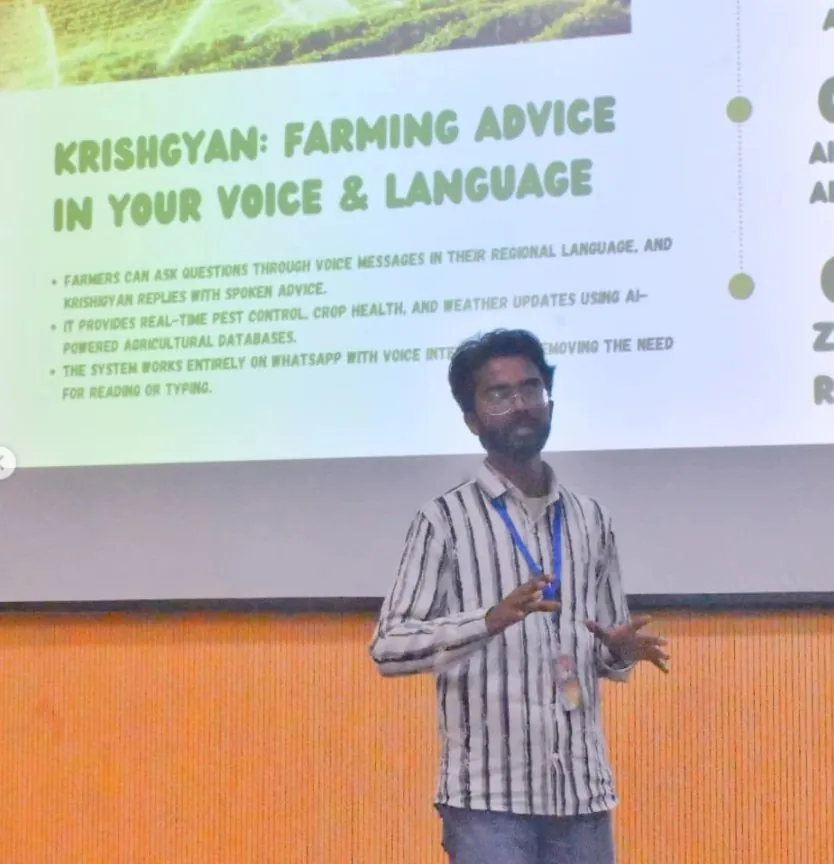
Rural deployments face limited connectivity, varied lighting, older phones and many languages, so models must be small, work offline and present results in local languages through simple interfaces. Datasets such as PlantVillage enabled crop disease models, while retinal screening research showed AI could detect diabetic eye disease from photos. Tools like KrishGyan, which delivers farming advice in a farmer's own voice and language over WhatsApp, show how rural technology must meet people on familiar channels.
Sources
- Wikipedia, Computer visionen.wikipedia.org
- He et al., Deep Residual Learning for Image Recognitionarxiv.org
- OpenCV, Aboutopencv.org
- CVAT, repositorygithub.com
- Hughes and Salathé, An open access repository of images on plant health (PlantVillage)arxiv.org
- Gulshan et al., Deep learning for detection of diabetic retinopathy, JAMAjamanetwork.com

GenAI engineer and AI product builder with 2+ years shipping production-grade AI systems: RAG pipelines, fine-tuned LLMs, hybrid retrieval and multi-modal apps across vision, speech and OCR, architected end to end from ingestion to deployment. Leads engineering for SCULT INDIA's 14-member team, founded the 500+ member TechVerse Enclave community and has mentored 200+ students. Three hackathon first prizes: Changethon 2025 (IIT Roorkee), Product Genesis at Vividhotsava 2025 (CSJMU) and BYTEBATTLE (MeetKats).
Open to GenAI roles, hackathon judging, mentorship sessions and guest talks at colleges. For campus sessions the inviting institution covers the visit end to end: travel (a First AC train ticket for journeys up to five hours, a flight for anything longer), accommodation, meals, and pickup and drop; the honorarium and workshop fees are negotiable on WhatsApp or on the call, and requests are welcome from institutions that can cover the visit this way. Email pranjulrathour41@gmail.com.