Key takeaways
- GenAI interviews test whether you have shipped and can reason about trade-offs, not whether you can recite definitions.
- Every strong answer has the shape: definition in one sentence, when it applies, a trade-off, and a moment from a project where it mattered.
- Expect RAG, fine-tuning, prompting, agents and evaluation, plus one system design and one cost estimate. Prepare a story for each.
- Have one project you can walk through failure by failure. That walkthrough is the interview.
- Say "I don't know, here is how I would find out" when true. Interviewers hire that sentence.
What do GenAI engineer interviews actually ask?
Six things, in some order: LLM fundamentals, tokens, context, attention, hallucination; RAG, how you build and evaluate retrieval; fine-tuning, when and how with LoRA; prompting and agents, including safety; evaluation and cost, how you know it works and what it costs; and one system design where you assemble the pieces. Plus a walkthrough of a project you built, which is where most decisions get made. Definitions get you past the first minute. Trade-offs and stories get you the offer.
Also asked as: genai interview questions · generative ai interview questions · llm interview questions · llm interview questions and answers · genai engineer interview questions · ai engineer interview questions · generative ai interview questions and answers for freshers · llm engineer interview · rag interview questions
I have sat on both sides: interviewing candidates for SCULT INDIA and being interviewed for GenAI roles. The pattern is consistent enough that this page is the preparation I now give mentees, with the answers I would want to hear. Longer notes are on the portfolio [11][12].
The question is never really "what is RAG". The question is "have you built one, and do you know what broke". Answer the second question every time. Pranjul Rathour
LLM fundamentals: what will they ask?
Expect: what is a token and why does it matter for cost; what is the context window and one failure mode of long contexts; explain attention in one minute; what is hallucination and how do you manage it; open-weight versus API models for a given product; what is the difference between a base model and an instruct model. Answer each with the concept in one sentence, then a consequence for a product you built.
Also asked as: llm fundamentals interview questions · transformer interview questions · what is a token interview · attention mechanism interview question · hallucination interview question · context window interview question · llm basics interview
RAG interview questions
Expect: explain RAG end to end; why is chunking important and how do you choose a size; why add keyword search to embeddings; what does a reranker do; how do you evaluate retrieval separately from generation; how do you stop the model answering when the documents do not contain the answer; how would you handle multi-tenant documents. Every question maps to a stage of the pipeline; know the pipeline and you know the questions.
Also asked as: rag interview questions · rag interview questions and answers · retrieval augmented generation interview · vector database interview questions · embeddings interview questions · chunking interview questions · rag system design interview · rag evaluation interview
The paper to cite is Lewis et al. [1]; the metric framework most interviewers know is RAGAS [7]. The answer that separates candidates is to the evaluation question: "I measure retrieval recall on twenty labelled questions before I look at a single generated answer, because a system can be faithful to the wrong passage."
Fine-tuning interview questions
Expect: when would you fine-tune instead of using RAG; explain LoRA and QLoRA; how do you prepare a dataset; how do you read a loss curve; what is catastrophic forgetting; how do you evaluate a fine-tuned model honestly; can you fine-tune GPT. The trap question is "how would you teach the model our product facts", and the right answer is "I would not, I would retrieve them, and fine-tune only for the voice and format".
Also asked as: fine tuning interview questions · lora interview questions · qlora interview questions · peft interview questions · fine tuning vs rag interview question · llm training interview questions · instruction tuning interview · rlhf interview questions
Prompt engineering and agent interview questions
Expect: system prompt versus user prompt and why the split matters for security; what is prompt injection and how do you limit its damage; when does chain-of-thought help and when does it waste tokens; how do you test a prompt; what is an agent and where does the model's judgement actually belong; how would you stop an agent taking a harmful action; when is a workflow better than an agent. Safety questions are where candidates who have only prototyped get exposed.
Also asked as: prompt engineering interview questions · ai agent interview questions · agentic ai interview questions · prompt injection interview question · system prompt interview · tool calling interview · llm security interview questions · langchain interview questions
The references interviewers respect: chain-of-thought [5], ReAct for agents [6], OWASP for security [9], and Anthropic's guide for the workflow-versus-agent distinction [10]. The answer to "how do you stop a harmful action" is not a clever prompt; it is least-privilege tools and a human confirmation for anything irreversible.
Evaluation and cost questions
Expect: how do you know your system works; what metrics do you track; how do you test a prompt change before deploying; how much does this feature cost per month; how would you cut that cost in half; what do you log. The interviewer is testing whether you treat an LLM system like software. Answer with a fixed evaluation set, metrics per stage, a CI check, tokens logged per request, and a cost model: input plus output tokens times price times requests.
Also asked as: llm evaluation interview questions · how to evaluate llm interview · ai cost estimation interview · llm observability interview · llm testing interview · genai production interview questions · mlops for llm interview
System design questions for GenAI roles
Expect one design in 30 to 45 minutes: a support chatbot over company documents, a document extraction service, a coding assistant, a voice assistant for a regional language. Structure it: clarify users and constraints, draw the request path, name each component and its failure mode, say what you would measure, estimate cost, and state what you would cut for version one. Interviewers grade the trade-offs you name unprompted, not the boxes you draw.
Also asked as: genai system design interview · llm system design interview questions · design a chatbot interview · rag system design interview · ai system design questions · design an llm application interview · system design for ai engineer
Behavioural and project questions
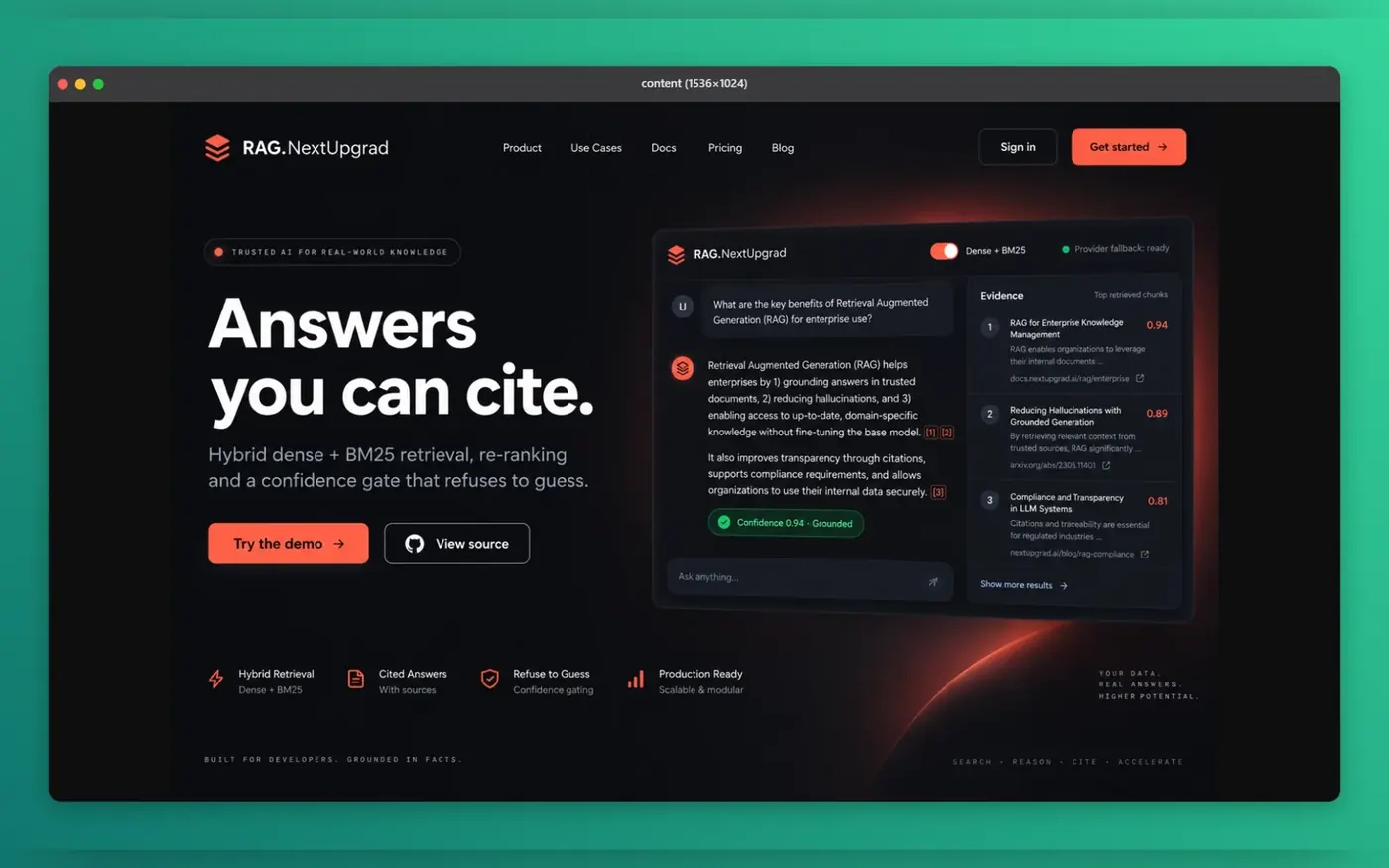
Expect: tell me about a project; what broke and what did you do; a time you disagreed with a technical decision; how you handle a requirement you think is wrong; why this role. For the project question, use one project and go deep: the problem, the decision you made, the failure you hit, the fix, the measured result. My RAG platform's confidence gate exists because of a failure; that story has done more for me in interviews than any definition.
Also asked as: tell me about a project interview ai · behavioural interview questions ai engineer · how to explain ai project in interview · how to present portfolio in interview · interview questions about failures · why do you want to work in ai interview
My separate note on the "tell me about a project" question, with the structure and a worked example, is on the portfolio [13].
Coding rounds for GenAI roles
Expect Python: parse and validate a JSON output against a schema; implement reciprocal rank fusion over two ranked lists; write a retry with backoff around an API call; chunk a text by paragraphs with a size cap; compute cosine similarity; write a small evaluation loop. Rarely leetcode-style puzzles. Write clear, typed, tested code, talk while you write, and handle the edge case out loud. The interviewer is watching how you work, not whether you finish.
Also asked as: coding questions for ai engineer interview · python interview questions for genai · llm coding interview · ai engineer coding round · machine learning coding interview questions · genai take home assignment
def reciprocal_rank_fusion(*ranked_lists: list[str], k: int = 60) -> list[str]:
    """Fuse ranked lists of ids; 1/(k+rank) per list, summed. A common coding-round question."""
    scores: dict[str, float] = {}
    for ranked in ranked_lists:
        for rank, doc_id in enumerate(ranked, start=1):
            scores[doc_id] = scores.get(doc_id, 0.0) + 1.0 / (k + rank)
    return sorted(scores, key=scores.get, reverse=True)
How should freshers prepare for a GenAI interview?
Build one RAG project and one fine-tune before the interview, so every answer has a story. Read four papers: transformer, RAG, LoRA, QLoRA. Write the evaluation set for your project, because the evaluation question is where freshers lose. Rehearse the project walkthrough with a timer, failure by failure. Prepare three questions to ask about how the team evaluates and ships. Then be honest about what you have not done; the sentence "I have not done that, here is how I would start" gets hired.
Also asked as: genai interview preparation for freshers · how to prepare for ai engineer interview · llm interview preparation · generative ai interview questions for freshers · ai interview tips · what to study for genai interview · genai interview roadmap
Questions to ask the interviewer
How do you evaluate model changes before they ship? What does your logging show for a bad answer? How often do requirements change and how do you handle it? Who owns prompt versions? What was the last production incident and what changed after? These tell you whether the team treats LLM systems as engineering, and they tell the interviewer you do.
Also asked as: questions to ask in ai engineer interview · questions to ask interviewer genai · what to ask ai team interview · reverse interview questions ai
Want a mock interview or a session for your batch?
I run GenAI interview preparation sessions for final-year batches and tech clubs, with a live system design and a project walkthrough clinic. Email pranjulrathour41@gmail.com or use pranjulrathour.scult.in/invite.
Sources
- Lewis et al., Retrieval-Augmented Generation for Knowledge-Intensive NLP Tasks (2020)arxiv.org
- Hu et al., LoRA: Low-Rank Adaptation of Large Language Models (2021)arxiv.org
- Dettmers et al., QLoRA: Efficient Finetuning of Quantized LLMs (2023)arxiv.org
- Vaswani et al., Attention Is All You Need (2017)arxiv.org
- Wei et al., Chain-of-Thought Prompting Elicits Reasoning in Large Language Models (2022)arxiv.org
- Yao et al., ReAct: Synergizing Reasoning and Acting in Language Models (2022)arxiv.org
- Es et al., RAGAS: Automated Evaluation of Retrieval Augmented Generation (2023)arxiv.org
- Liu et al., Lost in the Middle: How Language Models Use Long Contexts (2023)arxiv.org
- OWASP Top 10 for Large Language Model Applicationsowasp.org
- Anthropic, Building effective agents (2024)anthropic.com
- GenAI engineer interview questions, Pranjul Rathourpranjulrathour.scult.in
- Technical interview prep for GenAI roles, Pranjul Rathourpranjulrathour.scult.in
- Answering 'tell me about a project' in interviews, Pranjul Rathourpranjulrathour.scult.in

GenAI engineer and AI product builder with 2+ years shipping production-grade AI systems: RAG pipelines, fine-tuned LLMs, hybrid retrieval and multi-modal apps across vision, speech and OCR, architected end to end from ingestion to deployment. Leads engineering for SCULT INDIA's 14-member team, founded the 500+ member TechVerse Enclave community and has mentored 200+ students. Three hackathon first prizes: Changethon 2025 (IIT Roorkee), Product Genesis at Vividhotsava 2025 (CSJMU Kanpur) and BYTEBATTLE (MeetKats).
Open to GenAI roles, hackathon judging, mentorship sessions and guest talks at colleges. Email pranjulrathour41@gmail.com.