Key takeaways
- GenAI interviews test fundamentals (transformers, embeddings, attention), applied design (RAG, fine-tuning, evaluation) and one project you can defend in depth.
- Prepare a two-minute walkthrough of your best AI project: problem, architecture, a hard bug, how you measured quality.
- For coding rounds, master arrays, strings, hash maps, two pointers, sliding windows, trees, graphs and basic dynamic programming.
- Think aloud: restate the problem, give a brute force, improve it, then test edge cases before you say you are done.
- Practise on LeetCode or NeetCode by pattern, and do timed mock interviews with a friend or an AI interviewer.
The top GenAI interview questions test three things: whether you understand how large language models work (tokens, embeddings, attention), whether you can design a real system with them (retrieval-augmented generation, fine-tuning, evaluation, cost), and whether you can explain a project you built in depth. Coding rounds still test data structures and algorithms in Python or Java. This page lists the questions that come up most and how to answer them, the types of interview rounds, the coding problems to practise, and how to perform in a live coding round.
What are the top GenAI interview questions?
Expect questions on how LLMs work, how RAG and fine-tuning differ, how to evaluate outputs, how to reduce hallucinations, and how to control cost and latency. Then expect a deep dive into your own project.
Also asked as: top gen ai interview questions · what is genai interview questions · top 50 llm interview questions
Questions that come up again and again:
- What is a transformer, and what does attention do?
- What are embeddings, and how is semantic search built on them?
- RAG or fine-tuning: when would you use each?
- How do you chunk documents, and how do you choose chunk size?
- How do you evaluate a RAG system? Separate retrieval recall from answer faithfulness.
- How do you reduce hallucinations? Grounding, citations, refusal on weak evidence.
- What is LoRA, and why does it make fine-tuning cheaper?
- How do you handle prompt injection in an app with tools?
Answer each with a concept, a trade-off and an example from something you built.
What do GenAI interviews actually test?
They test whether you can ship, not just define terms. Interviewers check fundamentals, judgement about trade-offs, and evidence that you have built and debugged a real GenAI feature.
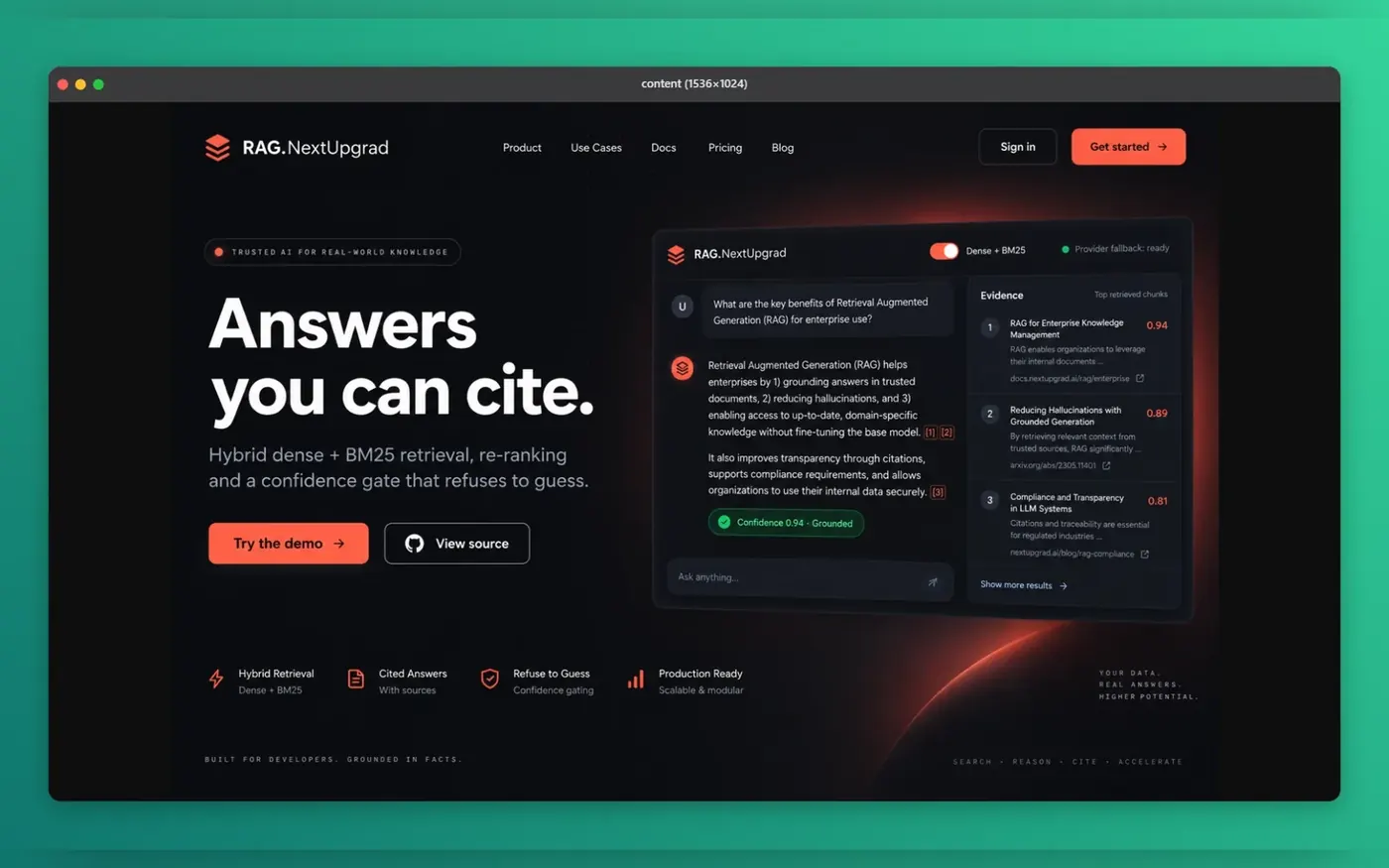
A typical GenAI role interview has a screening call, a coding round, a machine learning or GenAI concepts round, a system design round such as "design a document question-answering system for a company", and a project deep dive. The deep dive decides many offers. Prepare a two-minute walkthrough: the problem, the architecture, one hard bug, and how you measured quality. When I describe RAG.NextUpgrad, the parts that make the conversation are the specific choices: hybrid dense plus BM25 retrieval with reciprocal-rank fusion, re-ranking, and a confidence gate that refuses to answer on weak evidence. Specifics show you built it.
What are the most asked LLM interview questions?
The most asked LLM questions cover architecture, training, inference and safety. A focused list beats memorising fifty answers you cannot explain.
Prepare short, clear answers to these:
- What is tokenisation, and why do token counts matter for cost?
- Self-attention and multi-head attention, in plain words.
- Encoder, decoder and encoder-decoder models: examples of each.
- Pretraining versus instruction tuning versus RLHF.
- What does temperature do? What is top-p sampling?
- What is a context window, and what happens when you exceed it?
- KV cache: why it speeds up generation.
- Quantisation: what 4-bit loading trades away.
- LoRA and QLoRA: what is trained and what is frozen.
- Why do models hallucinate, and how do you measure it?
For each, have one sentence of definition and one practical consequence.
What do LLM interview questions test?
They test whether you understand why models behave as they do, so you can make engineering decisions: which model to use, how to prompt it, when to retrieve, when to fine-tune, and how to keep cost and latency under control.
Also asked as: what is llm interview questions
Interviewers rarely want maths for its own sake. A question about temperature is really asking whether you know to use low temperature for extraction and higher for brainstorming. A question about context windows is asking whether you know that stuffing more text can make answers worse, and that retrieval of the right passages beats long prompts. A question about fine-tuning is asking whether you know it changes behaviour and format, while RAG supplies facts. Link every answer to a decision you would make in a product.
What types of questions are asked in an interview?
Most tech interviews mix four types: technical concept questions, coding problems, design questions, and behavioural questions about how you work with people and handle problems.
Also asked as: which type of questions asked in interview
What each type looks for:
- Concept questions check fundamentals in your area, such as Python, databases, networks or LLMs.
- Coding problems check problem solving and clean code under time pressure.
- Design questions check how you structure a system and reason about trade-offs.
- Behavioural questions, such as "tell me about a conflict in your team", check ownership and communication.
For behavioural answers use the STAR structure: situation, task, action, result. Prepare five stories from projects, hackathons or college work that you can adapt to most questions.
What are the top Python coding interview questions?
Common Python coding questions are classic problems on arrays, strings and hash maps, plus Python-specific checks on lists, dictionaries, generators and complexity.
Also asked as: top coding interview questions python
Practise these until you can solve them cleanly:
- Two Sum with a dictionary in one pass.
- Valid parentheses with a stack.
- Longest substring without repeating characters with a sliding window.
- Group anagrams with a dictionary of sorted keys.
- Merge intervals after sorting.
- Top K frequent elements with
collections.Counteror a heap. - Binary search on a sorted array, and its variants.
- Level-order traversal of a binary tree with
collections.deque.
Also expect Python questions: list versus tuple, how dictionaries work, mutable default arguments, generators and yield, and the time complexity of common operations.
What are the top coding interview questions in Java?
Java coding rounds use the same core problems as any language, with extra questions on collections, object-oriented design and Java specifics such as HashMap internals and immutability.
Also asked as: top interview coding questions in java
The problem list overlaps with Python: Two Sum, reverse a linked list, detect a cycle, merge two sorted lists, valid parentheses, binary tree traversals, lowest common ancestor, number of islands with BFS or DFS, and simple dynamic programming such as climbing stairs and coin change. Java-specific topics to revise:
HashMapversusTreeMapversusLinkedHashMap, and how hashing and collisions work.Stringimmutability,StringBuilder, andequalsversus==.- Interfaces versus abstract classes.
- Checked versus unchecked exceptions.
- Basic concurrency: threads,
synchronizedandExecutorService.
Write clean method signatures and name variables well; it shows.
How do I answer coding interview questions?
Talk through a clear process: clarify the problem, give a simple solution, improve it, write clean code, then test it with edge cases. Interviewers grade your reasoning as much as the final answer.
Also asked as: how to answer coding interview questions · where to practice coding interview questions
A structure that works in every round:
- Restate the problem and ask about input size, edge cases and constraints.
- Describe a brute-force solution and its complexity in one sentence.
- Find the bottleneck and improve it, usually with a hash map, two pointers, sorting or a heap.
- Write the code while explaining each part.
- Walk through a small example and edge cases: empty input, one element, duplicates.
- State the final time and space complexity.
If you get stuck, say what you are trying. Silence is the worst signal in a coding round.
How should I code during an interview?
Write readable code first and clever code never. Use clear names, small helper functions and simple control flow, and test as you go rather than at the end.
Also asked as: how to code interview questions
Practical habits:
- Choose the language you are fastest in, usually Python, unless the role requires another.
- Write the function signature and a few test calls before the body.
- Prefer standard library tools such as
collectionsandheapqin Python. - Avoid premature optimisation; get a correct solution, then improve it.
- Handle edge cases explicitly instead of hoping they work.
In online assessments, read all the problems first and start with the one you can finish. Partial but correct solutions often score better than ambitious unfinished ones.
Where can I practise coding interview questions?
LeetCode is the standard practice platform, and NeetCode organises the most useful LeetCode problems by pattern with video explanations. HackerRank and Codeforces are also widely used for assessments and contests.
Practise by pattern, not at random: arrays and hashing, two pointers, sliding window, stack, binary search, linked lists, trees, graphs, heaps, backtracking and dynamic programming. Solve a few problems per pattern until you can recognise it in a new problem. Track problems you could not solve and redo them a week later. Add timed mock interviews with a friend, a mentor or an AI interviewer that asks you to explain aloud. For GenAI roles, also build and deploy one small RAG project, because a working project answers many interview questions at once.
Sources
- Vaswani et al., Attention Is All You Need (2017)arxiv.org
- Lewis et al., Retrieval-Augmented Generation for Knowledge-Intensive NLP Tasks (2020)arxiv.org
- Hu et al., LoRA: Low-Rank Adaptation of Large Language Models (2021)arxiv.org
- LeetCode, practice problemsleetcode.com
- NeetCode, coding interview roadmapneetcode.io

GenAI engineer and AI product builder with 2+ years shipping production-grade AI systems: RAG pipelines, fine-tuned LLMs, hybrid retrieval and multi-modal apps across vision, speech and OCR, architected end to end from ingestion to deployment. Leads engineering for SCULT INDIA's 14-member team, founded the 500+ member TechVerse Enclave community and has mentored 200+ students. Three hackathon first prizes: Changethon 2025 (IIT Roorkee), Product Genesis at Vividhotsava 2025 (CSJMU) and BYTEBATTLE (MeetKats).
Open to GenAI roles, hackathon judging, mentorship sessions and guest talks at colleges. For campus sessions the inviting institution covers the visit end to end: travel (a First AC train ticket for journeys up to five hours, a flight for anything longer), accommodation, meals, and pickup and drop; the honorarium and workshop fees are negotiable on WhatsApp or on the call, and requests are welcome from institutions that can cover the visit this way. Email pranjulrathour41@gmail.com.